A Different Philosophy: Stress, Progesterone, and the Will to Stay Sex-Positive in a Post-Roe America
Every morning, long before I’m ready to greet the day, I wake in a feverish burst due to a quiet strain in my abdomen letting me know I need to pee. At night, that same quiet strain keeps me from falling asleep. Sometimes, I’ll visit the bathroom four or five times in the span of an hour until I’m so delirious, sleep no longer becomes a choice. I was unfamiliar with this symptom of anxiety until I visited an out-of-network doctor at Wellness at Century City, who specializes in hormones.
Prior to the appointment, I found myself in a downpour in St. Tropez. I was wearing a floral dress that flipped up in the ultra-classic, Marilyn Monroe kind of way. My mother and I were drinking red wine beneath an awning on a cobblestone street, and I remember looking at her and saying, “It’s like I don’t know how to enjoy myself.”
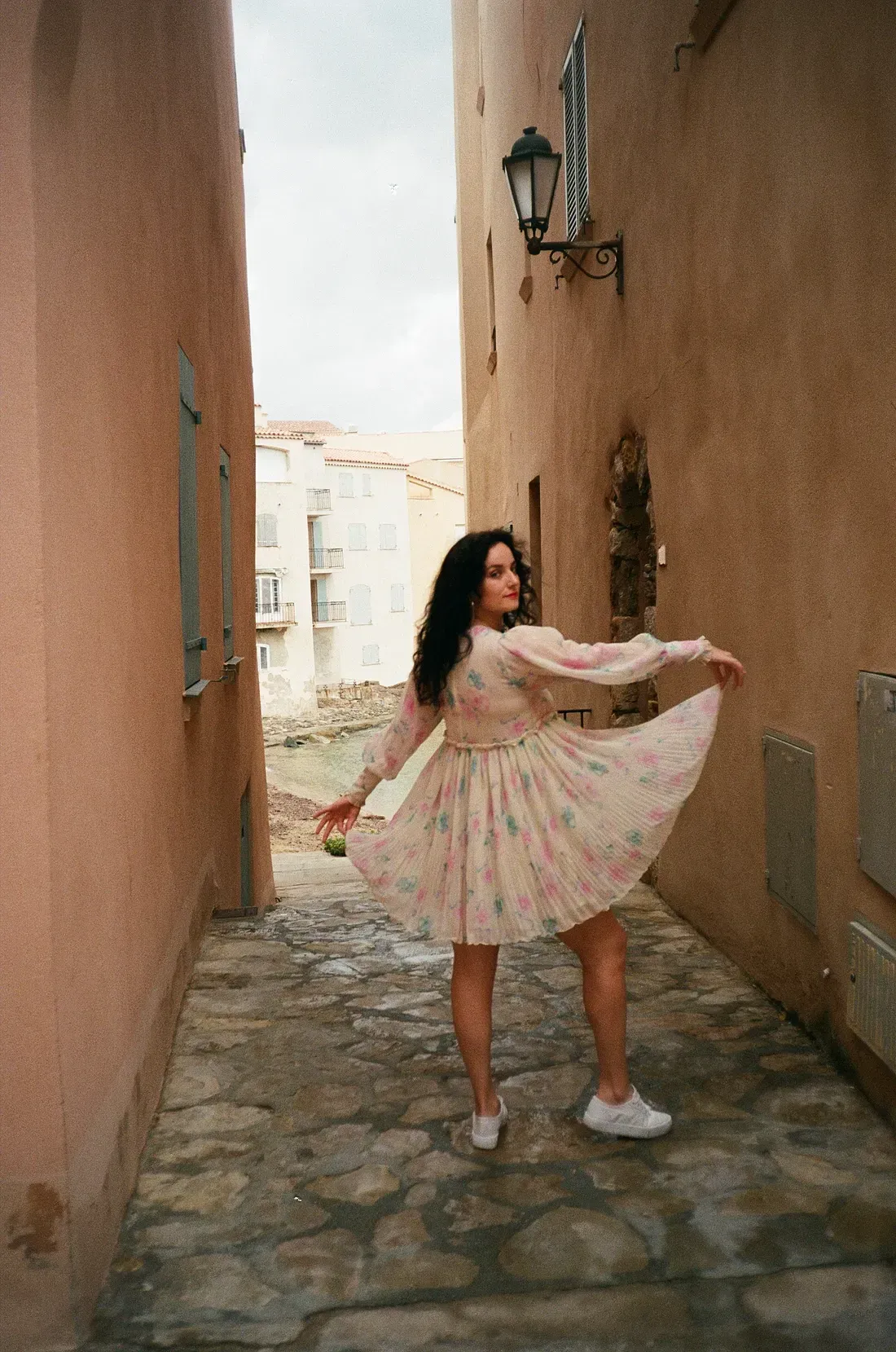
Romanticism and privilege aside, this moment is mentionable because of the setting. I’m a writer, and therefore fundamentally lustful towards the act of getting caught in the rain. And even there, in my most ideal setting, I could not figure out how to be happy.
Progesterone, commonly referred to as the “happy hormone,” is vital to maintaining mood.
While my mother indiscreetly secondhand smoked the cigarette at the table adjacent, having divorced cigarettes in the nineties, I listened to the rain beat down and scolded myself for not having a better time. I was a classic subscriber to the kick-yourself-while-you’re-down mentality that fueled America’s GDP, and in times of misery without reason (or so I thought), I gave in to this sinister thought: dying would just be easier.
A year later, when I sat down in Dr. Jessica Cho’s office and she asked me what kind of help I was seeking, I told her I felt “fat and lethargic” despite my regimented diet and guilt-fueled obsession with daily exercise. I wasn’t concerned with happiness at that point. I wasn’t concerned with my period, or fitful sleep, or any of the other unmentionables I had yet to be told were dysfunctional. I was only fixated on the most societally incorrect of my laundry list of issues. Why didn’t I look good? And why didn’t I have enough energy to keep up with modern capitalism?
“Can I feel your wrist?” Dr. Cho asked, almost as if she hadn’t heard me.
Before I could think twice about this response — or lack thereof — I leaned forward, stretching my tattooed arm towards her in a sign of obligation and consent. It was an odd dichotomy: confessing I didn’t identify with mankind’s devotion to medical ignorance by lifting the veil on what I’d been told were normal side effects of womanhood, while also extending my arm in her direction without first asking why. The ferocity of my humanity always dissipated in these types of situations. I didn’t feel at liberty to disagree with a doctor, simply because I didn’t know any better. I needed healthcare, so I willingly entered into a toxic relationship with it at birth.
In 2018, TIME magazine published an article titled “How To Tell If You’re In a Toxic Relationship — And What To Do About It.” Using this article as a barometer, I was able to determine that I was in a toxic relationship with healthcare on the basis that I routinely felt undermined, disrespected, and unsupported, and left most my appointments feeling anxious and unheard. It was no different than the relationship I’d had with my father, where the power was lopsided, and my ignorance was routinely preyed upon. And just as it took resources to escape that relationship, it takes resources to ask for second opinions, educate yourself, or seek out alternative medicines. In all other instances — of which there are far too many — you’re at the mercy of an industry that has more in common with an autobody shop than anything else.
To think any field, however altruistic its roots, wasn’t totally in it for financial gain would be terribly green. In Michael Lewis’s book, The Big Short, Dr. Mike Burry discusses the importance of incentives, and how hospitals with higher reimbursement rates for appendectomies removed more appendixes. On the sidewalk outside the Regal Theater in Opry Mills, a friend told me she got her pap smears at the Tennessee Department of Health before she was insured, and her results almost always came back as “abnormal.” This resulted in referrals to specialists she couldn’t afford and bi-annual visits to monitor, despite never receiving any concrete answers as to what exactly was yielding these supposed abnormalities. The health department was playing ping-pong with her pap smear results and inducing health-related panic to — in her opinion — squeeze as much money out of her as they could. When she finally got health insurance and was able to handpick her gynecologist, she never had an alarming pap smear again.
It was a recollection like this, shared without emphasis, popping up mid-conversation like a random restaurant recommendation or stunt abroad, that reminded me that healthcare owned me. Doctors owned me. Even Dr. Cho — in effect, one of the “good guys,” — owned me. She took my arm in her cold, delicate hands, bowed her head, nodded a few times, grunted in surprise at others, and then thanked me. In the thirty seconds we were quietly conjoined, adjusting the masks over our mouths, she was able to divine, from simply feeling the meridians in my body, that I was catastrophically stressed.
“Even sitting here,” she observed, “the image of calm. Your heart is racing.”
We all have events in our lives that sever our ties to Western theories of justice. Events that separate our years into two parts: before the event, and after the event, whereas the event propels you into a reality where your understanding of fairness in the world is completely shattered.
This was one such event for me.
For my entire life, I had been told, or it had been implied, that my fatness was my fault. Identity, for me, was synonymous with weight. I was a girl first, straight second, and big third. Moreover, an unspoken truth I’d been forced to adopt after a particularly demoralizing pity party in my late teens was that I didn’t try hard enough to be skinny. Dr. Cho conjectured that my weight could be traced back to the moment my mother and father came together in a series of heavy breaths and muscles spasms. When one sperm rendezvoused with one egg, and eventually became me.
This is not an outspoken battle cry of predeterminism from a devoted member of the woo-woo sisterhood, this is the lament of a misunderstood woman: you can inherit stress, and stress, in a roundabout way, makes you fat.
Finding out my weight could be explained by something other than my own shortcomings fast-tracked me to a new reality where my upper middle-class parents had had all the resources in the world to investigate my childhood weight gain further, but instead, due to an emerging marketplace that profited off the stigmatization of plus-sized peoples, assumed my inability to lose weight was my fault. Suddenly, the constant cries of “nobody understands me!” after fitful middle school sleepovers, during which I relentlessly interrogated my cohorts for some kind of indication that my anxious preoccupation with dying was normal, became less unreasonable and just sad.
In times of high stress, during long stretches of chronic stress, when your identity seems to be the ironic side plot and your anxiety the uncompromising main character, or even when anxiety is just an undercurrent to daily life, your adrenal glands produce cortisol, the main stress hormone. In moderation, cortisol helps regulate your blood pressure and increases inflammation to protect you from infection. When you’re in danger, it causes a spike in blood sugar, which gives you a quick boost of energy should you need to physically escape and restores balance thereafter. “Danger” used in this instance is more of an abstract term. Many situations your body registers as dangerous may appear characteristically undangerous to you. To the Sympathetic Nervous System, famous for triggering “fight or flight” mode, all stresses, both evident and obscure, are treated as equal, and experienced chronically, these stresses can lead to an excess in cortisol.
Aside from the obvious — unrelenting work-related pressure, a recent life event like a move or the loss of a loved one, anxiety disorders, or any stressful experience that is less episodic and more continual — silent killers like poor self-esteem and excessive screentime are also prima benefactors for the overabundance of cortisol. “Doomscrolling” and “trauma porn,” cutesy terms coined in recent years to describe the widespread obsession with, and exposure to, negative, hysterical media, incite feelings of dysphoria and are often seen as unavoidable. It’s a privilege to feel left out, and that privilege is capitalized on by social media platforms with algorithms that award the young and restless and promote the go-go-go attitude and compulsion to earn sleep that leaves us feeling overworked, drained and — ultimately — stressed.
I was newly eager to unload onto Dr. Cho, hoping every other hard truth I’d come by in my life could likewise be explained. I told her I was an anxious child. I became fixated on the afterlife in third grade, and often cried myself to sleep over the vagueness of death. I told her I gained sympathy weight with my mother in middle school when she was diagnosed with carbon monoxide poisoning. I told her I first became aware of my fatness when I heard my father whispering to my mother through a closed door that “something needs to be done about her weight.”
She nodded as I spoke. In truth, she reminded me of a mad scientist — mad because she was giving women, and people with female reproductive organs, answers. And after I’d finished my long-winded monologue about how bad I’d had it in a totally non-unique way, she said of two things she was fairly certain: I’d inherited stress from one, or both, of my parents, and I had a progesterone deficiency dating back to puberty.
But she wasn’t done yet. There were gaps in my soliloquy she wanted to fill. Gaps I hadn’t thought to mention due to societal influence, where the standard is overworking and women’s issues are taboo.
She asked me if I gained copious amounts of weight before my period. I remember feeling almost taken aback by that question. Violated. How could she know this intimate detail about me I’d barely acknowledged myself?
I nodded.
“So, in essence,” she said, “you look ugly for half the month.”
I wanted to scream, yes, yes, that’s absolutely correct! You see!
She asked me how many times I woke up in the night.
“Nine or ten,” I responded. “To pee.”
Thinking back, it seems absurd I thought waking up almost a dozen times in the night was normal. But the world had begun mirroring a sort of absurd theater by that time and I genuinely didn’t know any better. I was aware that a persistent need to pee could be related to stress, but I didn’t know it could extend into the night. I was asleep — in essence, hitting pause on my stress and resuming it again the next day. I blamed the innumerable nightly interruptions on late-night consumption, or too much sugar intake throughout the day. In actuality, the involuntary act of tensing up and squeezing my bladder was a by-product of anxiety, and at 25, Dr. Cho said I should be able to drink a whole bottle of wine right before bed, eat like a growing boy, and still sleep through the night.
I was dumbfounded.
She asked me if I had ever been successful losing weight. I told her between the ages of 20 and 22 I’d managed to lose 40 pounds before hitting a plateau. A year later, I went through a breakup and learned the secret to getting to the other side of that plateau was to stop eating. It was the one time I’d been able to hit the ideal weight for a 5’8” female, according to the CDC and, to this day, the plainness of that injustice has never stopped bothering me.
This all gave Dr. Cho pause. She looked at me, really looked at me, like I was a bit of an oversharer, but an oversharer who’d accomplished the impossible. Assumedly, I had an overabundance of cortisol in my body, given that I’d been in fight or flight mode since I was a kid. Assumedly, that had led to estrogen dominance in my hormones. Assumedly, that was why I complained of cravings, water retention, and a slower metabolic rate. And assumedly, all that came together to make losing weight hopeless for me.
There is a long explanation for the synergistic relationship between cortisol and progesterone, but to be brief, when the body is stressed, it uses progesterone to create cortisol. This meant that “the happy hormone” I needed to maintain my mood and regulate my period was being whacked out by the stress I had possibly inherited from my parents and the anxiety I felt about things I couldn’t control. Like my weight, like my career, like the world at large making choices for me I challenge.
She sent me down the hall to a room with all the traditional doctor’s office things: a bed lined with paper that tore if you breathed too close to it, jars filled with popsicle sticks that had me salivating like one of Pavlov’s dogs, and art that was dull and unmemorable. A few minutes passed. I looked out the window at Los Angeles in the bored way of Angelenos who’d tired of perfect weather. A nurse, juggling three or four small glass tubes, entered the exam room. After a brief questionnaire, she began filling the vials with my blood. She was fervent that we weren’t running tests because we were looking for something. Dr. Cho had seen this a million times before. Misunderstood women and people with female reproductive systems were her niche, and I was another of the collective whose denial Judith Grisel would say is strange. We were running tests for proof, so she could confirm that what she already knew was wrong was, indeed, wrong.
On the drive home, I was enraged.
I had been told my entire life that I was fat. That despite fad diets like Ideal Protein, South Beach Diet, Weight Watchers; despite the small case of workout bulimia I’d developed my junior year of high school; despite the doctors who’d tinkered with my thyroid and naturopaths who’d given me strange supplements that looked like powdered eggs and never dissolved in water like they said they would; despite every futile and grand effort I had made, it was my fault that I was fat.
And that was the moment I realized the world was hellbent on keeping women in chains.
Suddenly, I was the one family member at Christmas dinner who had been to therapy. The ignorant girlfriend who was now in possession of some damning text messages. I was wide awake, and our grand suffering was inescapable. At dinners, at concerts, in Ubers, at bars, on the beach, on my couch, god damn everywhere, I listened to what had become so systematically and usually discussed in my friend group, but for which I could no longer write off as normal: late periods, missed periods, lethargy, fitful sleep, mood swings, back pain, irritability, PMS, weight gain, yeast infections and on, and on, and on. It only served to infuriate me further that each time I asked if they’d had their hormones checked, not a single one of them could even say they had thought to.
Unless you’re going through menopause, struggling to conceive, or specifically ask, your hormones will not be prioritized during your routine physical. Common check-ups will be a vague overview of general health and delving deeper without cause will only be covered by your insurance as a preventative visit… if you’re lucky.
Following a brief discussion about the general negligence of Western medicine as it relates to premature birth rates, saving technologies, and racial disparity, a doctor of homeopathy named Marnie Reasor told me she’d experienced suicidal thoughts in her twenties she believed were linked to her hormones. While the intuitive powers of women have long been overlooked, her doctors agreed to test her blood for any discrepancies. Her results came back normal, not because her hormones were balanced, but because they’d failed to carry out the test during the mid-luteal phase of her period, which is five to seven days after ovulation occurs when our sex hormones are at their peak. Testing during the luteal phase is crucial to uncovering any abnormalities, as the luteal phase in and of itself can tell us important things about our hormones. For instance, if your luteal phase ends prematurely, it can be a sign that your body isn’t producing enough progesterone, and progesterone is considered key for healthy conception.
Understanding menstrual cycles seems like a very basic prerequisite to working in health care. In principle, half the people receiving health care have female reproductive organs and tend to weather repeated hearsay objections when asserting their intuition about their bodies. It’s next-level brainwashing disguised as healthcare, where the emphasis is on health and not on care — a notion that is heavily asserted in Dána-Ain Davis’s book, Reproductive Injustice. Thus, these women and people with female reproductive organs will continue to buy the lie that they’re sleeping well, their irregular, painful periods are a simple side effect of having a female reproductive system, their back pain is a symptom of getting older, and their dryness during sex means they’re not turned on enough.
As a collective we have been wholly unprepared by middle school and high school educators who taught us the bare bones of what the government considers to be essential sexual education. According to “Sex: The Taboo Education,” a TEDx Talk given in Bozeman, Montana, where I was raised, sex educators were told to push abstinence first, preventing HIV second. Anything extra fell on the teacher’s own political self-identification and was not a required part of the curriculum.
To Judith Grisel’s point about our collective ignorance, I couldn’t take it any longer. I approached the women and people with female reproductive organs in my life and handed them keys, keys to their personal freedoms, keys that were our birthright, but that had become one more privilege in a world that values saving over prevention. In Billings, expecting pushback from a friend studying to earn her DNP, who works in healthcare and has long touted Western medicine, I was pleasantly surprised to lock eyes with an ally. She smiled at me, piloting our golf cart around a tree in sought of her wayward ball, and said, “If they gave us progesterone and rights, we would take over the world.”
My labs came back in late November of 2020 and served as the evidentiary support for Dr. Cho’s testimony: I was progesterone deficient and genetically predisposed to higher stress levels. My stress hormone state-adrenal fatigue the day of testing was so high, it was almost as if I was in a perpetual state of panic. And I was insulin resistant, a common pathological condition that often goes undiagnosed in women and causes obesity. She packaged these findings up into a petite binder, pushed them across her desk towards me, and ironically called them the “Weight Loss Trifecta,” whereas, the combination of stress, insulin resistance, and estrogen dominance makes it nearly impossible to lose weight, even if I did everything right.
To treat, I was given topical progesterone, a bottle of little chartreuse-colored pills called Synjardy, Ashwagandha in both pill and powder form, and a new mountain to climb: the medical patriarchy.
And climb I did.
I became relentlessly devoted to debunking every lie I had ever been told. I read books like Quit Like a Woman, where Holly Whitaker theorizes that alcohol companies specifically target women; Come as You Are, a revolutionary look into the sex lives of women — what turns us on, what turns us off, and how it’s all normal and okay — and The Will to Change, the first bit of literature I’d held in my hands that truly challenged the definition of the modern-day feminist, a.k.a. man hater.
It was almost a form of self-flagellation — scouring the Internet, looking for ways I had been ill-prepared as a woman to thrive in this world. There were small furies and there were large furies, and perhaps the largest of them all was the link I finally drew between alcohol, caffeine, and the main female sex hormones.
Perhaps I hadn’t paid enough attention in Science class, or perhaps there was a more sinister reason the relationship between hormone regulation and the liver went unmentioned — or without emphasis — while Mesopotamia’s rivers and climate are ingrained in memory like my first hangover. In meme culture, it’s common to criticize high school education for failing to prime teenagers for adult life. But rather than questioning where general health falls in the hierarchy of important subjects, we laugh about “adulting,” doing taxes, and planning for retirement, completely overlooking the liver’s tendency to become overworked, and the chaos that ensues therein.
The term “loaded liver,” refers to a liver so inundated with toxins, it’s no longer able to do its regular job efficiently. It becomes overwhelmed and backloaded with a constant influx of pollutants hiding in plain sight, like air pollution, microplastics, and synthetic additives in our skincare, resulting in an inability to attend to its core duties, like hormone regulation. Getting real about the legitimate consequences of ingesting substances that induce liver toxicity, many of which have been widely exonerated for their profitability, means going up against industries responsible for creating millions of jobs and pulling in trillions of dollars in revenue each year. Industries that thrive on Schadenfreude.
Two liver loaders in our daily lives, alcohol and caffeine, are so commonplace, we often relax into them for their ability to loosen us up and provide us with the energy to “do life.” If your consumption is high and regular, your liver function becomes sluggish, physically manifesting in fatigue, weight gain, cravings, headaches, etc. Even hormonal birth control and popular behind-the-counter medications like Fluconazole, or “Diflucan,” prescribed for yeast infections, are considered liver loaders.
Returning to the conversation I had about the general negligence of Western medicine, I was not told until my third or fourth visit to the Hollywood Walk-in Clinic in Los Angeles specifically seeking Diflucan, to refrain from consuming alcohol while taking the antifungal because it’s notoriously hard on the liver. By that point, they were generously prescribing them to me in multiples of ten, which I was instructed to take once a day until the infection subsided.
As someone suffering from a chronic yeast infection, Diflucan had become something I couldn’t live without, and on no occasions had I been offered an alternative treatment. I felt betrayed and defeated, and it wasn’t until I conducted my own research that I discovered that boric acid suppositories, such as the ones sold by Love Wellness, are a more effective and far less harmful solution to the pH balance in your vagina.
Friends who’ve poked fun at the handfuls of vitamins I take morning and night like to joke that even my vagina takes vitamins.
There wasn’t a single person in my life with female reproductive organs, myself included, who hadn’t been offered birth control by one doctor or another as a cure-all to symptoms like depression, acne, and painful periods, or as a simple introduction into womanhood. In my teens, I remember girlfriends of mine flaunting their birth control around like it was something to be proud of. My uber granola mother, whose spirituality went so far back, she remembers having to find books on meditation in occult bookstores in Minneapolis in the 80s, forbade me from taking this normalized step into female maturity. She had her own reasons, but a friend of hers who’d never been able to conceive strongly believed birth control was to blame. Now, imagining the level of manipulation and brainwashing that goes into pill-pushing, this pride in being on birth control is as absurd to me as the idea I once had that I slept well, despite waking up every hour to use the bathroom in the night.
Fortunately, detoxing from birth control has found support on TikTok and other social media apps. Despite being led to believe in a fall-out of crazy symptoms, many reported their acne getting no worse. Some stopped spotting, some felt more energized and content, and some were relieved from constant bloating.
“Now my suspicions that [birth control] was actually the problem for the last 10 years are pretty much confirmed,” one friend said.
In the two years following my diagnosis, I lost ten pounds, often slept through the night thanks to stress supplements like Ashwagandha and Theanine Serene, and no longer gained an unreasonable amount of weight leading up to my cycle. It was a success story, but one I couldn’t see through to its end owing to the pricey out-of-network visits. At the end of 2021, I relocated to Nashville, and visited an OBGYN named Dr. Anne Rossell for a routine pap smear and breast exam. I told her my story, how I had relocated to Nashville, how the move had been hard on me and my relationship, how a small depression and listlessness had resulted, and how my anxiety had ramped up over the summer. I expected a back-and-forth of sorts, or an acknowledgement of my pain, but Dr. Rossell only wanted to talk about remedies. And remedies, in her experience, were birth control, antidepressants and other mood-stabilizing meds. It was debilitating how wide she cast this net, as though these three things were the only things we, as women and people with female reproductive organs, needed to be caught. And while you’ll never hear me knock meds, because who am I to question what works for one person — what, perhaps, saved another from detriment — you’ll never see me make that leap without exploring less invasive alternatives first.
I made it clear I was disinterested in medication, that I’d found success in talk therapy and leaned on vitamins, minerals, and herbs for anxiety relief. She nodded, and that was that. I was disappointed, having hoped for more insight, and finding instead that she didn’t expand on my research at all. She came to my bedside and began the two-fingered pat-down of my breasts, talking — about what I can’t remember — but in such a way that elucidated how little chemistry we possessed as patient and doctor. I felt newly vulnerable and scared when she’d finished, pulling my gown around me, and spreading my legs so she could examine my pelvis. She continued to talk, and I continued to listen, and near the end, after several pinches, pokes and prods, I expressed my desire to have my hormones tested.
Whatever spell she had been under, whatever notion she had that we were somehow on the same team, seemed to wear off. She told me she didn’t believe in testing my hormones without cause, and that it would be “difficult finding an OBGYN that will test for hormones or supplement progesterone.”
I sat up and asked her why.
As she discarded her gloves, she explained that “progesterone can increase risk of breast cancer,” while progesterone deficiency/estrogen dominance is also known to cause cancer.
“It’s a different philosophy,” she continued, to which I almost responded, “what? Health?”
“Progesterone is a depressant,” she offered by way of explanation. “I tell my patients who take it to be wary of feeling depressed.”
I caught myself before I did something inappropriate, like scream or roll my eyes, her words transporting me back to St. Tropez, to that Marilyn Monroe dress, to perfect circumstances, to a time without progesterone when I couldn’t stabilize my mood, when happiness was ephemeral, and when dying felt easier.
I posed this hypothetical: “Say we do my bloodwork, and you find out that I have no progesterone — you wouldn’t do anything about that?”
“No, because everything else is working just fine. Your period is normal.”
Yet, I had opened my brief life story with an admission of depression and exposed her to my history with progesterone.
I muttered a rather icy goodbye and left her office disillusioned and confused. I questioned the article I was working on day-in and day-out. I questioned Dr. Cho. I questioned everything. And I wondered if she did it all on purpose.
Later on in the day, as I was mopping my sweat after a brief session at a sauna studio near me, I received a phone call from her office, a woman, whose name I didn’t get, but who I assume works at the front desk, notifying me that, “Dr. Rossell had continued to think about your story and would actually like to test on day 3 and day 21 of your cycle.”
I thought about the fight I put up in that room, and how uneducated I was in comparison to her, but how educated I was in comparison to most everyone else. I thought about how many women and people with female reproductive organs had walked through her doors and believed in her different philosophy. And it all filled me wrath. Would it always be this hard? Would only the ones starved for information they sequentially felt responsible for distributing to the masses be able to save us? It was no longer about women and those of us with female reproductive systems. It was about the world at large. It was about Maya Angelou’s assertion that “when you learn, teach.”
On the day the Supreme Court of the United States overturned Roe v. Wade, I woke in the usual way: I had to pee. I grabbed my phone, sat down on the toilet, and reached between my legs for my Diva Cup, a small bell-shaped, silicone basin that captures menstrual fluid instead of absorbing it, as a tampon would (since writing this article, we now know, on top of all else, tampons are toxic). I’ve found that women are more likely to be repulsed by the concept of a menstrual cup than men are. It’s not so strange. I used to be one of them. I had an intrinsic fear of my vulva. I didn’t want to touch it. I ignored the smells associated with it. I never peered below my navel when considering myself in the mirror. I whispered the word “vagina” in conversation. And I certainly never masturbated with my fingers. One very grave day in 2019, I realized, to my utter horror, that all my ex-boyfriends were on better terms with my vulva than I had ever been and, due to a deep-seeded shame of my own sexuality, would probably ever be.
It seemed a fatal flaw that any woman could be repulsed by the Diva Cup — more accurately, by handling the fluids associated with our menstrual cycles. But after careful consideration, I realized it wasn’t odd at all. It just made sense. We had been told our periods were disgusting by at least one person in our lives at one time, and it is universally acknowledged that you shouldn’t hold something disgusting in your hands.
I know women and people with menstrual cycles who despise their periods for every valid reason under the sun. Because it’s irregular. Because they identify as a man. Because they’re trying to conceive. Because they associate it with pain, etc. I was grateful to love mine. Despite some body aches and back pain, it was regular, and I took each period as an indication that my body was functioning the way it was meant to. When abortion bans in the past weren’t absolute, but stricter, I was privileged to have a period I could depend on for its predictability. Being that pregnancy is estimated from the first day of your last cycle — something the masses don’t realize — six-week bans would require diligence on my part. But I could be diligent. I could make it work. The question of whether I should have to make it work was never one I thought I’d be asking again when, according to the National Institute of Child Health and Human Development, almost a quarter of women and people with menstrual cycles have irregular periods. And, for them, six-week bans would feel absolute, like a total attack on their autonomy.
After rinsing out the cup, folding it in half widthwise to minimize surface area, and reinserting it into my vagina, I checked my phone. And there it was. SCOTUS had overturned Roe v. Wade.
I remember my initial reaction was to read the fine print. What was I missing? I had to be missing something, some tiny detail that made it make sense. But there were no special clauses. Roe v. Wade was simply no longer the law of the land, and the rage I felt was akin to the rage of finding out I was progesterone deficient. I started to cry, as I once had on the drive home from Dr. Cho’s. I cried and cried and cried, and I watched myself in my mirror thinking this is what heartbreak looks like. I left the bathroom and sidled up against my bedroom window, where the train was going by, and overgrown vines were encroaching on my back patio. In a month’s time, I would have them removed, and the hillside would look like it’d been wiped away by a SoCal mudflow.
I was furious. I was furious at those vines. I was furious at America. I was furious that millions of women and people with female reproductive organs were wandering around thinking their irregular or painful or short or long periods were normal. I was furious that a country without universal healthcare, without the erudition to identify racial disparity as a race issue and not a class issue, and with so little insight into female body parts that they often unknowingly referred to the vulva as a vagina, could force women and people who can get pregnant into carrying a child against their will. I was furious to be so misunderstood, to call my mom and have her soothe me with promises that “this just means they’re losing. This is just an act of desperation — one final grasp for control.”
My boyfriend entered the room. Beyond a groggy acknowledgement at dawn that he was off to the gym, and I was sleeping in — as was the case most weekday mornings — we hadn’t yet greeted each other. It felt like a small fury in the grand scheme of things, but a fury no less, that we hadn’t touched or kissed or shared a private moment in our private lives before the news cycle tore through yet one more gentle morning with an unwelcome announcement, the same way it broadcasted school shootings and police brutality. As he walked over, I performed a spiritual pat-down of sorts, checking myself for sincerity. I think many women would echo the sentiment that they feel responsible for justifying their emotions. He said his usual, “Hey,” rested a hand on my shoulder, and peered around at me.
“Oh no, are you okay?” he asked.
“They overturned Roe v. Wade, Eric,” I said.
This was only the third or fourth time he had seen me cry in the span of the year and a half we had been dating.
He laid his head on my shoulder and held me.
My grief, spilled all over our bedroom, seemed to wake Eric up to what this landmark decision meant for him. One of the first divisive conversations we’d had was about children: he didn’t want them, and I did. He didn’t believe people took child rearing seriously.
Furthermore, he thought most people lacked the ability to look at the bigger picture and were clouded by idealistic views of suburbia. When I’d told him I believed I’d be a good mother, he was firm that he believed that too, but that simply believing you could do something doesn’t mean you should. He would be right, and I would never look at the young parents around me with the same wistfulness I once had again.
He was always looking at the bigger picture, and that morning was no exception. He feared for what this decision would mean for privacy. He didn’t believe in the government interfering with our personhood. He believed what goes on in our home should be our business, and our business alone. I stared out the window, anxiety building, cortisol releasing, progesterone deteriorating, and Eric trauma-scrolled through news articles, through facts and exaggerations, through the inner-workings of the trigger bans, and the inevitabilities that 13 more states would follow suit with their own laws, some inflexible and totally absolute.
Throughout the day he checked on me. He packed a soft cooler with snacks and filled my water bottle in the event I decided to protest downtown that evening. He tiptoed around me, gauging my upset, and dealt with the lawn guy when he came over to assess our weeds. I was upset. I was mad at him. We lived in the same house, we both worked from home, we both laughed and had a biological process, we both cared for our families and sent birthday presents to our friends, we both believed the earth was round. So, why was I the only one who lost her rights that day?
It wasn’t his fault the ban didn’t hold men responsible for partial childcare — which includes financial and otherwise. It wasn’t his fault everyone was pretending like child support is the most uncomplicated, implied, and non-negotiable thing in the world. It wasn’t his fault that I woke up that day with less rights than my mother had at my age. None of it was his fault. But I was mad at him anyway. Because he had no responsibility to the unborn. And I could die during a forced birth. I was mad at him for the contingencies.
But more than that, I was mad that my sex life would continue to suffer beneath this patriarchal regime. Taking ownership of my healthcare, looking for answers, becoming the sole proprietor of my body, refusing to buy the lie that my weight was my fault — it all served as a radical self-awakening to my own intrinsic sexuality. I was now a woman who looked at her vulva in the mirror, who was not ashamed of her fantasies, who watched herself masturbate, and lovingly reminded herself not to spectate — a term picked up in Emily Nagoski’s book, Come As You Are, meaning the act of observing physical intimacy rather than being fully present for it. I had been handed a new freedom when I realized I was allowed to explore, and just as quickly I had seen it torn away.
Before labels, when Eric and I were just an idea in my head, I became determined not to make the same mistake I had in the codependent partnership we succeeded. I needed to get familiar with my female parts, more familiar than any man would be. That was my duty, as integral and evident as the liver’s devotion to detoxification. I was supposed to love every slick, soft, dry, and hairy part of it. If not me, if not the government, who else?
I had to undo every unfriendly thought I had about my vulva and every bad habit I had picked up trying to be sex-positive in a society that seeks to punish women and people with female reproductive systems for wanting to have sex. In a journal entry I wrote about masturbating with my fingers for the first time, I described the immediate aftereffect of my orgasm as a feeling of plenty. I was cashing in on all the hard work I had done unravelling every archaic train of thought I’d once blindly followed about female sexuality so I could do this one divinely feminine thing for myself. It wasn’t about coming. It was about stepping fully into my power.
I rigorously stroked two fingers over the most intimate, and politicized part of my body, and propelled myself into a new reality where gate-keeping my sexuality wasn’t out of respect for my parents or my purity or my desirability, but a deliberate and effective tactic to keep me from discovering how truly powerful I am.
After I left the window and Eric went to work, which is to say, after we set this new American trauma aside and resumed our lives, I pulled my Beats over my head and listened to “Nothing Left to Lose” by Kari Kimmell. She sang of an emptiness that lasted forever, and I pictured it in 4D. In that continuum, I deliriously painted by number on an old stylist gaming device in my childhood bedroom until I was worn out enough to sleep. Next to her, the woman I am now painted at the kitchen counter with a watercolor kit I’d just picked up from Michael’s, hoping to quiet my mind enough to eat.
Would being alive always be so painful? Would progress always feel so eerily similar to hitting a wall? And if it was this agonizing for me, what did it feel like to be erased from the conversation about reproductive rights as somebody who’s non-binary-defined? What did it feel like to live below the poverty line without access to sexual education and, causally, preventative measures? What did it feel like to be a Black woman living in Jackson, Mississippi, a trigger ban state assigned an F by the March of Dimes in 2021, where the rate of preterm births for Black women is 17.4 percent, 5.2 percent higher than white women and 7.3 percent higher than the national average?
What did it feel like to be non-white, non-affluent, uneducated, unsupported and without a regular period?
I would never know. And neither would most of the people responsible for overturning Roe.
Recent Posts