I was an hour and a half into my flight to Paris when the pilot announced over the loudspeaker that there was an oxygen leak in the cockpit and, as a result, we’d be diverting back to JFK. I had just taken melatonin and was brushing my teeth. When I slipped back into my seat, the man in front of me explained to his wife that it wasn’t to be dwelt on. It was like a light coming on in her car, only this was a plane, and for all manner of liability issues, it couldn’t go ignored as hers often did. Assuming he wasn’t a complete layperson, I was pacified for the hour and a half it took to get back to Jamaica Bay. Just a light on the dash. Sure, okay.
We made it back to JFK, stranded on the tarmac at one in the morning looking for crew to man the jet bridge and the helpdesk, to be bodies for angry, overtired passengers flooding into the terminal with their small and large furies to bully. At this time, there were a series of contradicting announcements. For my part, I was up and down, up and down, collecting my belongings, preparing to deplane, then seated again with my things stowed. Standing again, my bags at the ready, then sitting back down in a huff because the gate agents said to.
What I couldn’t see past was how cushy this dance was in Delta One. While there were passengers in middle seats in coach going through this ordeal with children, with varying levels of financial comfortability, having been to Europe before, or having saved up for a trip for however many months or years, I had an entire cubby of space, water, and peace of mind. It was, as always, an unavoidable class issue—I knew I would be among the first to reach the help desk, that my status meant I could call Delta right then and there and get straight through to a representative, that mine was the business Delta couldn’t afford to lose.
When we were escorted off the plane, we were told to sit in the terminal with our belongings and await news. Initially, I sat near the podium, next to the man and wife and their two kids, one of which looked eerily like Anne Frank and brushed her hair out for twenty minutes, a clump of it sitting in her lap, and of little import to her. In fact, she fell asleep with it there. And that, combined with the masses and hordes of individualists prepared to take their singular tragedy out on a gate agent who was there, working overtime to supply us with answers they were getting in the same timeline we were receiving them, pushed me to a small, empty corridor where I could find some semblance of quiet.
It was always alarming to see humanity up close like this. To realize how many of us were hell-bent on our victimization, on resorting to anger and exasperation, as though shit doesn’t happen all the time, to every type of person, with or without cause. There were so many levels of circumstance in that terminal, and I felt hopeless sitting in the middle of it all, knowing how many of their problems, their hurts, their fears, could be resolved if wealth was more evenly distributed, and if scarcity wasn’t the single-most acknowledged universal truth.
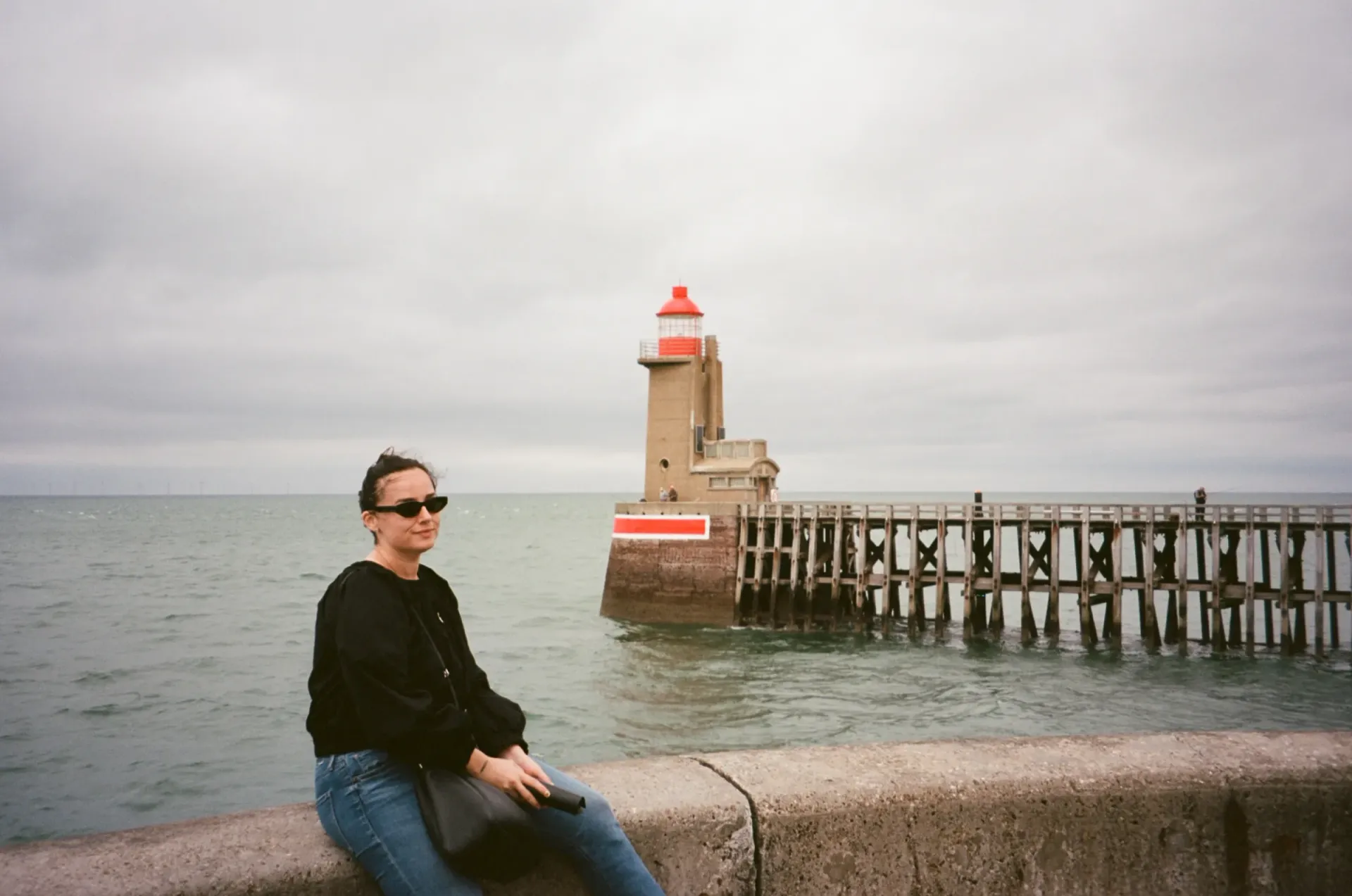
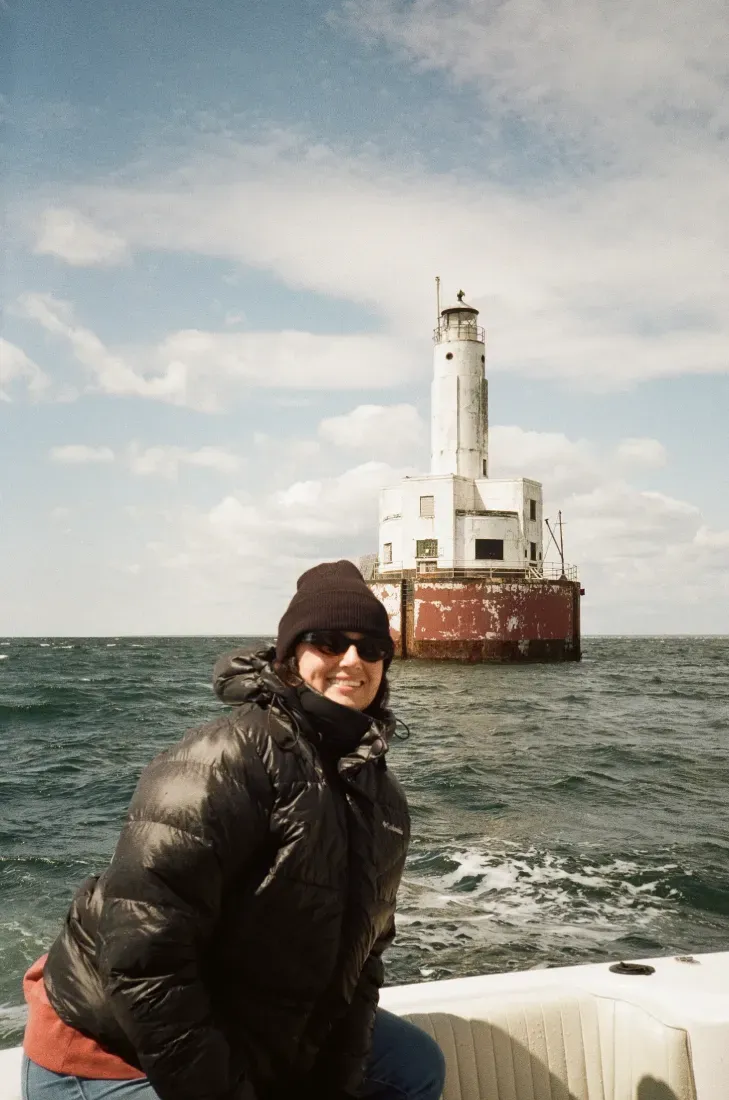
I had been on the search for lighthouses in the U.S. for four years by that point, having seen 359 of the 790 still mostly standing, and was headed to France to see all the lighthouses along the coast from Saint-Malo to Amsterdam, Netherlands. In my search, I was routinely confronted by a rampant individualism. I’d spent most of my summer in 2024 in the mid-west, speaking with locals and small business owners who were so brazen and open with their COVID-era racism against Asian people, it made me realize how bad things had gotten way out there in the rural, mostly forgotten areas of our country. Out where they trusted the promise of a “businessman” and believed he alone could lead them to Jerusalem. There was little pushback in these parts of the world, where the community had been born, raised, and settled in the same place, had little aspirations to leave, and had never been exposed to anything but an echo of their same beliefs. And it had mostly happened in our periphery, meaning, we were all partially responsible for this cancer that was spreading.
I had experienced more travel debacles than not when I set out to see all of America’s lighthouses in 2024, but each time I was met with one enduring thought: it was important to go out and meet with the world in this way. To see all its working and broken parts up close. To see the messiness, how we were split into hordes of people who felt unseen, and all in a different way. How each time something happened, like a flight cancellation, pain came pouring out of them, and it was never in proportion to the offending event.
In summary, people everywhere were not okay.
After two long hours of intermittent updates that “there are no updates,” the flight was cancelled. The crowd was united in its disapproval, groaning to mobile positions, listening closely to their options: visit the help desk, get rebooked or be refunded. If we wanted our luggage, there would be a two- to three-hour wait, as there was no crew to operate the baggage claim. By this time, I had already spoken to a Delta representative who’d assured me that if the worst happened, which it did, I’d be immediately booked onto a flight leaving at six-thirty that evening.
“Just like that?” I asked her. She assured me, yes, “just like that.”
Well, it wasn’t “just like that.” I reloaded my app, hoping to see a new ticket issued, and was met with the same message about my now obsolete flight—that it was delayed. Check back later. I called Delta and was put through to someone else. Unfortunately, I wasn’t rebooked. They could rebook me, but all she had on offer was a new itinerary that went through Cincinnati. Seeing the line of exhausted passengers with their monstrous, sleep-deprived children and piles of unchecked goods breathing in and out in a way that made me think all of society was on the verge of collapse, I told her to book it and approached a separate help desk to ask if I could get my bags. He said I couldn’t, but he assured me my bags would follow me to Paris the next day. He was wired. He apologized for a mess that wasn’t his own, told me he had been working for over eighteen hours at that point, and held his hands up. I nodded, acknowledging his limit, and that was that.
I took small defeat after small defeat, pocketed my phone, and headed for the exit, passing that horde of people with only enough patience left in the tank to form a zig-zagged, mostly civilized line. I couldn’t help wondering what they were being told. And, if it was this bad for me, what would it be like for the rest of them?
It occurred to me that most people didn’t think like this. For a long time, I thought they did. But in the past however many years, I had come to realize that, in general, people think of their lives in a singular way, with very little in their periphery. And what was there was mostly threatening. The world was scary when you paid attention. Most of them didn’t have the capacity for unique thought. Most of them were worried about scarcity and annihilation, the news pumping them full of hatred towards minorities. It was as roundabout and backwards as diverting me through Cincinnati. I wandered through the halls of an eerily empty JFK, and I thought about the fact that tomorrow afternoon, after over twenty-four hours of travel, I’d be almost exactly as far from Paris as I once was in Nashville. I’d made no progress, and it was all out of my control. It felt deeply, uncomfortably familiar.
I needed a hotel. I took a train from terminal 4 to terminal 5 and thought about the TikTok I could make if I went to the TWA hotel. A way to explain the night from hell in a humorous fashion whilst also grasping for visibility. If nothing else, it would give the whole debacle purpose. As an artist and writer, it seemed my brain was always on the lookout, even when I was at the edge of consciousness, for an opportunity like this.
It was a long walk from the train. Rather, it felt long at four AM. Jamaica Bay was foggy and humid, not quite cold, but not quite warm. The parking garages were empty, and the path to TWA felt like a tromp through the set of Bladerunner. It was ominous, and the hotel itself was a behemoth—the way its architecture defied the harsh angles and squareness of modern buildings. I felt alien approaching it, my bags wearing on my shoulder, my spirit, and my patience. The lobby was huge and white, polka-dotted, like a scene straight out of The Jetsons, and when the late-night staff told me there was no vacancy, I left embarrassed, in a daze, wondering what I was to do. Actually, the most pressing of all my emotions was fear.
I felt inconvenienced and displaced in a mostly manageable way, even if I wanted to tell myself that nothing was okay. That I couldn’t be expected to hold it all together. That I should just give up, sit on a curb crying, waiting for more tragedy to strike or savior to come. I read once about the inexhaustible determination of those who weren’t white, because they’d never had the option of simply giving up. I couldn’t help thinking of the people in Iran. It was a time of horrific uncertainty in our world, and I had long learned how eager my brain was to perpetuate a cycle of despair in my life. To feel some sense of hopelessness at all hours of the day so I wouldn’t have to live in the discomfort of content. I told a friend how important it was to allow ourselves small personal wins, to live a life adjacent to tragedy. But to still live. Right then, my aim was to remind myself of how good life was if I was wandering around with the means to find a hotel, no matter the distance, and that it would be hard and I would be tired and all would feel really personal at this hour—after this day—but that I was safe.
I walked back to the train, miserable, calling hotels in the area hoping for vacancy where there was none. After many rounds of refresh, something in Rockaway opened up on Delta’s site. I called them in a panic and reserved a room. The relief was palpable. I finally had a place to go. I hadn’t realized how much of my anxiety was owed to aimlessness.
I took the train to Howard Beach, feeling every bump and twist and turn along the way, climbed into a Lyft and stared off into space for the entire twenty-five quiet, foggy, vacuous minutes to my hotel. In my room, I made urgent calls about my rental car to Avis, who directed me to a different Avis, who told me to call booking.com. I learned bits and pieces of information through various thick, European accents. I wouldn’t be there within 24 hours of the start of my rental, so I’d have to book a new one. Thankfully, only insane people would devise to drive a car in Paris, and there was plenty of availability.
Dealing with robot-menus in French at five in the morning was what finally put me over the edge. My endurance, however notable, had finally petered out. I dissolved into frustrated tears, wondering how everyone else was fairing. I was having a hard enough time as one person with disposable income. I was not a family searching for five seats on the same flight. I did not have a connection in Paris. All was, for the most part, well. I just needed to go to sleep.
I made one last call to my hotel in Paris, who said not to worry, my room would be ready for me at whatever hour I arrived. I filled out a reimbursement ticket on Delta’s website. Then I shut my laptop, showered, did what I could to wash my clothes in the sink, and went to slept without my pillow, sound machine, or sleep supplements. I woke in a sweat. I turned on the AC. I woke in a panic. And then finally, I woke to the alarm.
The hotel arranged for me to be driven to the airport by the general manager. A Black man in his thirties who apologized for poking and prodding at my “lighthouse thing” as we sat in traffic. We had a conversation that felt so modern, so healing, like an understanding among two people who couldn’t understand each other even if they tried. We spoke of reparations for Black people, of a two-party system enslaved by the same oligarch, of Rockaway’s strange isolation, of mass consumerism, of his Caribbean grandmother who was spartan in her living, who wanted for nothing, not even a patch in her leaky roof, because she wasn’t around anyone who had anything to speak of. I had never thought of it like that. How proximity inspires desire. How I grew up with entrepreneurs and people who had seen the world, and how that had built in my subconscious like a disease. And when he dropped me off, he shook my hand, and met my eyes, and I remember thinking this was what it was all about. This moment of human connection, when one person in distress about the world felt an interruption. I complimented the brown crystal hanging around his neck, wrapped in wire.
“It’s good to protect yourself,” I said.
“That’s what I’m all about,” he said back to me, clutching at his necklace. “Protection.”
We should all shield ourselves in this way. Be so informed, but also, find respite. Find a way to be in a world that is uncertain and overwrought and ripe with dissatisfaction, war, and greed. I thought at once how I was deep in a new normal. That what I was experiencing wouldn’t be so outlier in the future. This was the way of things. Chaos was taking over, systems were breaking down, flights were less and less dependable, especially with less ground control. I could no longer travel without a cushion period. I would have to make room for this. There were billions of us here, going about their lives business as usual, flying during the worst of times, and all I could do was accept this and move on.
It turned out, my baggage didn’t go to the claim, as I was promised. They would not be following me to Paris if I didn’t go retrieve them. The things stacked up, but I would persevere.
I went downstairs and sat in line waiting, making small talk with a couple who were very good at taking things personal. When I got to the desk, the agent couldn’t say for sure where my luggage was. Luckily, I could. After a gut-wrenching theft in the Geneva airport in 2024, all my luggage had Airtags, and I could tell from my app they were in the storage room I’d watched him go in and out of no less than a dozen times. Together, we raked through the aisles of bags, and when I found mine, I rolled them into the bathroom to change my clothes. I was relieved to have access to my anxiety supplements and contact solution, a few necessary dribbles into my cup. I zipped my bags back up, walked from whence I came, and checked myself in.
At security, a line for Delta One customers only, I asked for a hand check for my film. With the way things were going, it shouldn’t have surprised me when they got a somewhat iffy response from whatever residue they’d picked up on the case, which resulted in my getting a very intense and in-depth pat down. I stood there as a woman dragged her hands all over my body and I was reminded of a quote by Olga Ravn:
“I just want to be a body […] with no one able to make contact with that body anymore.”
All my things were touched. My computers. My jewelry. My journal. The junction between my legs, “where my hands meet resistance,” the TSA agent had explained. I was so humiliated.
It was this humanity, this moment of grief, that brought me back to those in the middle east. Sheltering if shelter was available, carrying their children to safety over and over again, carrying an entire civilization on their backs as people summered in Tel Aviv. How could you not be filled with despair for them every time you were inconvenienced in some small or big way? How could you not immediately relate these grievances back to the biggest inconveniences of all: a loss of a home, a community, and a right to exist?
I sat in the Delta One lounge, watching Krysten Ritter walk by, picking at a plate of food, talking to my boyfriend on the phone about our new compost bin, which had newly exposed me to the sheer amount of food waste I, as a singular person, was responsible for.
“I’m in such a mess,” I told him then. And I didn’t mean the flight to Cincinnati. The nearly 48 hours of travel it would take to get to Paris. The obscene pat down. I meant the world.
We were in such a mess. And as I sat on that flight, and I listened to Brad Mehldau playing the Beatles, I wrote this out in the most urgent of pleas. Today I was driven to discomfort, as we all would be in the end, if we didn’t wake up.
And soon.